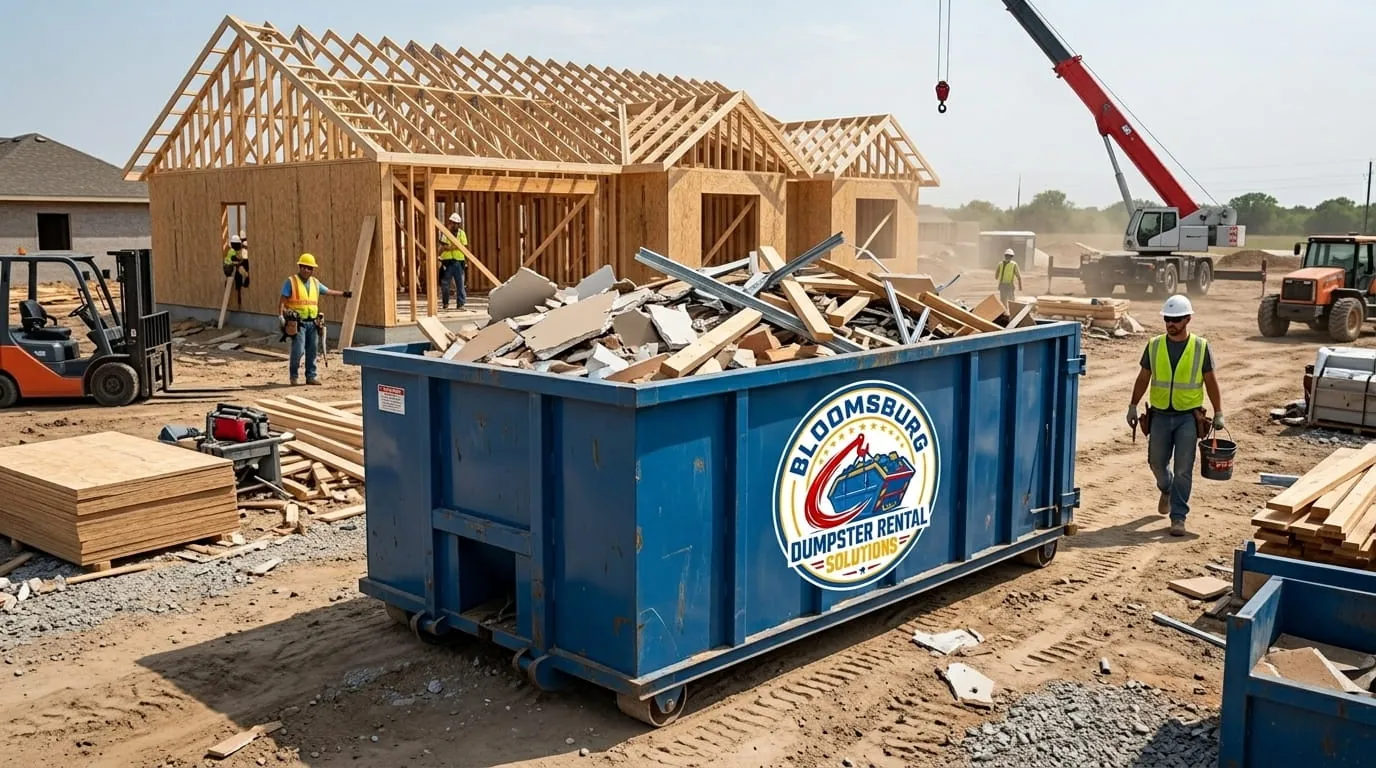
Ask any roofer around Bloomsburg what surprises the new guys most, and it usually isn't the pitch or the heat off a dark roof in July. It's the weight. A pile of stripped shingles looks manageable sitting in the driveway. Then you try to move the container, or the delivery driver mentions the ton limit, and the math gets real fast. Shingles are one of the heaviest common debris types we handle in Columbia County, pound for cubic foot, and getting the dumpster wrong on a tear-off is an expensive lesson.
This is a guide to sizing that container correctly. We'll do the actual weight math on squares and bundles, talk through single versus multi-layer tear-offs, explain why the 10 and 15 yard boxes are the workhorses for residential roofing, and cover the practical stuff that trips crews up: driveway placement, swaps on bigger jobs, and how to keep from paying overage you didn't budget for.
Why roofing debris is so heavy
Asphalt shingles are basically fiberglass mat soaked in asphalt and coated in mineral granules. That granule layer is crushed rock. It's dense, and it holds water, which is why a roof that came off after a rainy stretch weighs noticeably more than one torn on a dry week. Add in old felt paper, drip edge, the occasional rotted decking board, and the nails, and you've got a debris stream that fills a container by weight long before it fills it by volume.
That last point is the one people miss. Most dumpster debris is limited by volume, you run out of room before you run out of weight allowance. Roofing is the opposite. You'll hit the tonnage cap with the box maybe two-thirds full. That's normal, and it's exactly why roofing gets smaller containers than a garage cleanout would.
The shingle weight math
Roofers measure in squares. One square equals 100 square feet of roof area, and it takes three bundles of standard architectural shingles to cover a square. Here's the rule of thumb we use, and it's held up across hundreds of local jobs:
- One square of single-layer asphalt shingle weighs roughly 230 to 260 pounds once torn off. Call it 250 to be safe.
- That means about 8 squares of tear-off equals roughly one ton.
- A bundle runs about 75 to 85 pounds. Three bundles to a square, so figure a bundle at a quarter of that square weight.
Now put a real roof to it. A modest ranch here in town might be 15 squares. Single layer, that's about 3,750 pounds, so just under two tons. A larger two-story with a couple of gables and steeper pitch could run 30 squares, which lands you around 7,500 pounds, close to four tons, on a single layer alone. Those numbers should immediately tell you why a roofing container and a household-junk container are sized so differently.
Heavier product changes the math too. Dimensional and premium architectural shingles weigh more than the old three-tab. Slate, tile, or cedar shake is a different animal entirely and pushes weight way up, so if you're stripping anything other than asphalt, tell us up front so we can size and price it right.
Single-layer versus multi-layer tear-offs
Here's where a lot of estimates go sideways. Plenty of older homes around Columbia County have had a second roof laid right over the first at some point, and occasionally a third. Every layer you strip multiplies the weight by roughly that same 250 pounds per square.
Take that 20 square roof. Single layer, you're near 5,000 pounds. Two layers, you're near 10,000, five full tons of debris coming off a house that looked identical from the street. If you sized the container for one layer and hit two, you're either splitting the load across an unexpected swap or eating overage charges. Before you order, get up there and count layers at a rake edge or a valley. It takes two minutes and it's the single most important number for sizing the box.
If you genuinely don't know, size up. It's cheaper to have a little room left over than to have a half-stripped roof and a full container on a Friday afternoon.
The 10 to 15 yard sweet spot
For the vast majority of residential roofing dumpster rental jobs, the answer is a 10 or 15 yard container, and here's the reasoning.
A 10 yard box handles roughly 10 to 12 squares of single-layer tear-off comfortably within a typical weight allowance. That covers a lot of smaller ranches, garages, additions, and porch roofs. It's low to the ground, easy to toss into, and it fits on a tight driveway without much fuss.
The 15 yard dumpster is the true workhorse of residential roofing. It gives you room for roughly 15 to 18 squares of single-layer, or a smaller multi-layer job, while keeping the walls low enough that your crew isn't heaving bundles over their heads all day. That toss height matters more than people think on a long strip. It's the size we recommend most often for a standard house here, and it's usually the best balance of capacity, cost, and weight allowance.
Why not just grab a 20 or 30 yard box and be done with it? Because on roofing you'll never fill that volume, the weight cap stops you first, and you're paying for air. A big box also sits higher, so every shingle goes up and over a taller wall. For roofing specifically, right-sizing down and swapping if needed beats oversizing almost every time. The exception is a large commercial or multi-building job, where a bigger container staged for scheduled swaps makes sense.
Not sure which box fits your roof? Call Bloomsburg Dumpster Rental Solutions at (272) 203-8539 and give us your square count and layer count. We'll size it right the first time and tell you the honest weight allowance before anything leaves the yard.
Driveway placement for roofers
Where the box sits decides how fast your day goes. Get it right and your crew is dropping debris straight off the roof into the container. Get it wrong and you're wheelbarrowing shingles across a lawn.
A few things we tell every roofing crew:
- Stage it under the longest, most accessible eave you can. The closer the box sits to where the bulk of the roof lands, the fewer steps per bundle, and on a full tear-off that adds up to hours.
- Protect the driveway. Loaded roofing containers are heavy, and the delivery truck is heavier. Lay down a couple of sheets of plywood under the wheels and skids on fresh or sealed asphalt. It spreads the load and saves you a repair conversation with the homeowner.
- Leave overhead clear. The truck lifts the box high to set it and haul it. Watch for low power lines, tree limbs, and porch overhangs at the drop spot.
- Think about the truck's approach. We need a straight-ish shot in and room to raise the bed. A container wedged against a garage or boxed in by parked cars can't be swapped or hauled without moving things.
- Mind the tarps and the ground crew. Position so your catch tarps funnel toward the box, not away from it. A little planning here keeps granules out of the flower beds.
If the driveway genuinely won't work, the street is sometimes an option, but Bloomsburg and some of the surrounding boroughs require a permit for a container in the right-of-way. Ask us and we'll walk you through what your municipality needs.
Scheduling swaps on bigger jobs
On a large multi-layer tear-off, or a job with several structures, you're not going to fit it all in one box, and you shouldn't try. The move is a scheduled swap: we haul the full container and set an empty one so your crew never stops.
The key is timing it with your production. Tell us your start date and roughly how fast you strip, and we'll plan the swap so the empty lands before your crew tops out the first box, not two hours after. Roofing moves fast once the tear-off starts, and a crew standing around waiting on a container is money burning. A little coordination up front keeps everybody working.
For phased jobs, staging one container and pre-scheduling a same-day or next-morning swap usually beats renting two boxes at once, especially on a driveway that only has room for one. We do this constantly through the busy season, so if your timeline is tight, say so when you book.
A quick word on mixing debris
Keep the roofing container to roofing. It's tempting to throw in the old gutters, some siding, a few busted windows from the same project, and a little of that is usually fine. But loading a bunch of non-roofing junk into a box that's already going to max out on shingle weight just gets you to the cap sooner with less roof stripped. If you've got other demo debris, a separate box or a heads-up so we can size accordingly keeps the whole job clean.
The bottom line
Roofing is a weight game, not a volume game. Count your squares, count your layers, do the math at roughly 250 pounds a square, and match that to a container with the right tonnage allowance, usually a 10 or 15 yard box for a house. Place it tight to the work, protect the driveway, and schedule swaps ahead of your production on the big ones. Do that and the dumpster becomes the part of the job you never think about, which is exactly how it should be.
We've been sizing containers for roofers all over Columbia County for years, and we're happy to talk through your specific roof before you commit to anything. Reach out through our contact page or call and we'll get you set up.

Founder, Bloomsburg Dumpster Rental Solutions — sharing straight advice from more than 15 years of local hauling experience.