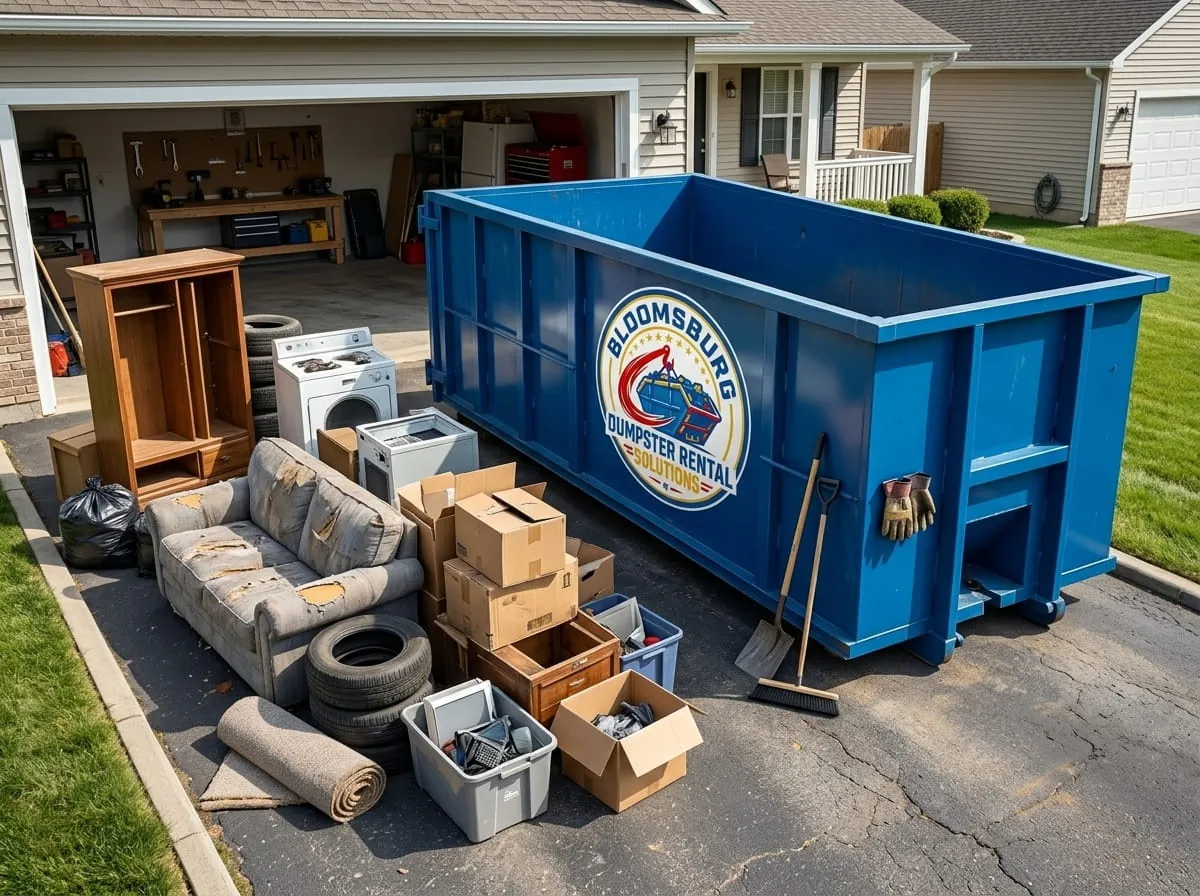
After enough years dropping roll-offs on driveways all over Columbia County, I can usually guess the right size before a customer finishes describing the job. But you shouldn't have to guess, and you definitely shouldn't be paying for air or, worse, standing over an overfilled bin we can't legally haul. So let's walk through the four sizes we run most often around Bloomsburg, what actually fits in each one, and how to land on the right call the first time.
The short version: match the box to the debris, not to your optimism about how much stuff you have. People almost always underestimate. Below is how to do it properly.
How dumpster sizes actually work
That "yard" number is cubic yards of volume, not the length or weight. A 20 yard dumpster holds 20 cubic yards of material, which is roughly eight to ten pickup-truck loads. The footprint on your driveway matters too, because a lot of folks worry about that more than the volume. Most of our roll-offs are between 7 and 8 feet wide and 22 feet long, so if you've got a standard two-car driveway, you have room.
The other number that trips people up is the weight limit, or tonnage. Every rental includes a set amount of weight, and going over it means overage fees at the scale. Volume and weight are two separate ceilings, and heavy debris like shingles, concrete, dirt, and plaster hits the weight ceiling long before the box looks full. More on that below, because it's the single most expensive mistake I see.
The 10 yard dumpster: small, heavy jobs and tight spaces
The 10 yarder is our little workhorse. It's around 12 to 14 feet long, 8 feet wide, and about 3.5 feet tall, so it tucks into short driveways and doesn't tower over the flower beds. Because those low walls make it easy to load by hand, it's the one I recommend for anything dense.
What it's built for:
- A single-room cleanout or a decluttered garage
- Small bathroom or kitchen demo
- Roughly 250 to 300 square feet of roofing tear-off (one layer)
- Concrete, dirt, brick, or other heavy material where you'll hit the weight cap fast
Here's the counterintuitive part: for heavy stuff, smaller is smarter. If you fill a big box with broken concrete, you'll blow past the tonnage limit and pay dearly, and we may not be able to haul it safely at all. A 10 yard bin caps the weight naturally. If your project is dense, this is often the right box even when it looks too small. Want the exact dimensions and weight allowance? We keep them on the 10 yard dumpster page.
The 15 yard dumpster: the in-between size people forget
The 15 yarder is the one nobody asks for by name, and it's a shame, because it's the sweet spot for a huge number of Bloomsburg projects. It gives you meaningfully more room than a 10 without the price jump of a 20, and the walls are still low enough to load comfortably.
I steer people here for:
- A whole-garage or basement cleanout with mixed junk
- Small-to-medium remodels, like a single bathroom gut plus flooring
- Deck tear-offs and fence removal
- Roofing jobs in the 350 to 450 square foot range
If a 10 feels tight but a 20 feels like overkill, this is almost always your answer. Estate cleanouts land here constantly, because you've got a mix of furniture, boxes, and the odd appliance, and 15 yards swallows it without leaving you paying for empty space.
The 20 yard dumpster: our most-rented box for a reason
If I had to bet on one size for a given driveway, it'd be the 20. It's the most popular roll-off we run, and it hits the balance most homeowners need: around 22 feet long, 8 feet wide, and roughly 4.5 feet tall. Big enough for real projects, low enough that you're not heaving debris over your head.
This is your box for:
- Whole-house cleanouts and big decluttering pushes
- Medium remodels touching two or three rooms
- Roofing tear-offs up to about 1,500 square feet of single-layer shingles
- Flooring, drywall, and cabinetry from a kitchen redo
- Large yard and storm cleanup
The reason it's our default recommendation is simple: most people underestimate their volume, and the gap in price between a 15 and a 20 is smaller than the cost of ordering a second haul because you ran out of room. If you're on the fence between two sizes and the debris is light, size up. You can read the full specs on the 20 yard dumpster page.
One note on roofing: shingles are heavy. A 20 yard box handles the volume of a mid-size roof easily, but we'll talk through the tonnage so you don't get surprised at the scale. That's a conversation worth having before the dumpster shows up, not after.
The 30 yard dumpster: big renovations and construction
The 30 is the big one, standing around 6 feet tall and 22 feet long. This is a contractor and heavy-remodel box, not a spring-cleaning box. When you've got serious bulk, it saves you swaps and keeps a jobsite clean.
Reach for the 30 when you're doing:
- Whole-house gut renovations
- New construction and large additions
- Commercial cleanouts and full property clear-outs
- Large-volume, lightweight debris like framing lumber, siding, and roofing over multiple layers
The catch with the 30 is the height. Those tall walls make hand-loading a chore, so it shines when you've got a machine, a crew, or bulky light material you can toss up and over. If your debris is heavy rather than bulky, don't jump to the 30 assuming bigger is better. You'll top out on weight with the box half full and pay for volume you never used. Heavy and dense means smaller box, more weight; light and bulky means bigger box.
Not sure which one fits your project? Call Bloomsburg Dumpster Rental Solutions at (272) 203-8539 and we'll size it with you in two minutes.
The weight-limit trap nobody warns you about
This is where the money is, so read this part twice. Every dumpster comes with an included weight allowance, and heavy materials will hit that ceiling long before the box is full. The usual culprits:
- Roofing shingles — dense, and they add up shockingly fast
- Concrete, brick, and asphalt — heavy enough that we often ask you to keep them in a dedicated small bin
- Dirt, sod, and gravel — the classic "why did I only fill it halfway" material
- Wet plaster and tile — heavier than they look
For clean loads of concrete or dirt, we'll usually put you in a 10 yarder and tell you not to fill it past a marked line. That's not us being stingy, it's the law of physics and the DOT weight limits our trucks have to obey. Mix your heavy stuff into a big box full of light junk and you'll get an overage bill that stings. When in doubt, tell us what the debris actually is, and we'll set the right size and the right tonnage together.
How to avoid over- and under-sizing
A few rules of thumb that have held up over hundreds of jobs:
- Walk the job before you order. Count the rooms, eyeball the piles, and be honest about what's hiding in the basement.
- When the debris is light, size up. The price gap between sizes is almost always cheaper than a second pickup and drop-off.
- When the debris is heavy, size down. Weight, not volume, is your limit. A smaller box protects you from overage fees.
- Don't plan to load above the rim. We can't haul a dumpster loaded over the top edge, it's not legal on the road. Level loads only.
- Ask about the heavy stuff separately. Concrete, dirt, and shingles usually deserve their own plan.
If you describe your project honestly, we'll match it correctly. We do this every day across Bloomsburg, Berwick, Danville, and the rest of Columbia County, and we'd rather talk you into the right box than watch you overpay for the wrong one.
One more thing worth planning for: timing. If you're renting for a remodel, order the box for the demo phase, not the day the project starts. Debris tends to come in waves, and a dumpster sitting empty for a week of framing is just a tripping hazard. And if you think you might fill it early, tell us up front. We can schedule a swap or a second box far more smoothly when it's on the calendar than when it's a Friday-afternoon scramble.
A quick size cheat sheet
To keep it simple, here's how I'd sum up the four in one line each:
- 10 yard — small cleanouts and anything heavy like concrete or dirt.
- 15 yard — the underrated middle child; garage and basement cleanouts, small remodels.
- 20 yard — the do-it-all box; whole-house cleanouts, medium remodels, most roofs.
- 30 yard — big renovations, construction, and bulky lightweight debris.
Print that on the fridge and you'll be right most of the time. For the edge cases, that's what the phone is for.
Still not sure? That's what we're here for
There's no shame in not knowing whether your kitchen remodel is a 15 or a 20, or whether that pile of old shingles needs a weight-capped 10. Sizing a dumpster is our job, not yours. Tell us the project, the materials, and roughly how much, and we'll give you a straight answer and a flat price with no surprises at the scale.
Ready to book or just want a second opinion on size? Get in touch or call (272) 203-8539. We'll get the right box on your driveway when you need it, and haul it away when you're done.

Founder, Bloomsburg Dumpster Rental Solutions — sharing straight advice from more than 15 years of local hauling experience.