Nobody hands you a manual for this. One week you are sitting with your mother at her kitchen table, and the next you are standing in that same kitchen holding her house key, wondering where a person is even supposed to begin. If you are reading this in Bloomsburg or somewhere out in Columbia County, and you have just been handed the job of clearing out a loved one's home, I want you to know two things up front. It is normal to feel paralyzed. And you do not have to do it all in one weekend.
I have spent years helping families here work through exactly this. The checklist below is the one I wish someone had given me the first time. It is practical, it moves in a sane order, and it leaves room for the grief that comes with every drawer you open.
Before you touch anything: give yourself a week to breathe
The single most common mistake I see is people rushing. A relative flies in from out of state, everyone feels the pressure of a limited window, and suddenly bags are going to the curb before anyone has checked what was inside them. Things get thrown away that can never be replaced. Slow down. The house is not going anywhere, and in most cases neither is the deadline you think you are under.
Use the first few days to do nothing but look. Walk each room. Take photos on your phone before anything moves, room by room, so there is a record of how your loved one kept their world. Those photos matter more than you would guess, both for family who cannot be there and for your own memory a year from now.
Step one: secure the valuables, documents, and anything that locks
Before sorting, before donating, before a single bag leaves the house, do a security sweep. This protects the estate and it protects you from the accusation that something went missing on your watch. Look for:
- Financial and legal papers — the will, deeds, titles, insurance policies, bank and brokerage statements, tax returns going back several years, pension and Social Security paperwork.
- Identification — Social Security card, passport, birth and marriage certificates, military records. Guard these; identity theft against the deceased is real and cruel.
- Cash and small valuables — older folks hide money. Check freezer bags, coat pockets, the backs of picture frames, taped under drawers, inside books, in coffee cans. I am not exaggerating.
- Jewelry, coins, watches, firearms — inventory these with a second family member present and photograph them. Firearms have their own transfer rules in Pennsylvania; set them aside and handle them properly.
- Keys, safe combinations, and digital access — safe deposit box keys, a list of online accounts, passwords written in the address book under a fake name. Look everywhere twice.
Put everything in one locked box or one clearly labeled bin that goes home with the executor that same day. Do not leave valuables in a house that contractors, buyers, or extended family will be walking through.
Step two: understand the executor's timeline so you are not fighting the clock blind
If you are the executor, the estate has a rhythm you should respect. In Pennsylvania you will typically open probate at the county Register of Wills, and there are real obligations: notifying creditors, filing an inheritance tax return, and eventually settling accounts. The point for cleanout purposes is simple. Do not dispose of assets of meaningful value until you know whether they need to be appraised or accounted for. Furniture, tools, vehicles, collections — if it could carry value, document it before it leaves.
At the same time, do not let probate become an excuse to freeze. You can absolutely sort, clean, donate the obvious low-value items, and prep the house while the legal process runs in parallel. Talk to the estate attorney once, ask what must be preserved, and then you have permission to move on everything else.
Step three: sort with a system, not with your emotions steering every item
Here is where families get stuck for months. Every object triggers a memory, and if you evaluate each one emotionally you will never finish. Give yourself a simple sorting framework and stick to it. I use five categories, and I physically mark areas or use colored tape:
- Keep — items a family member has genuinely claimed.
- Sentimental to review — photos, letters, a few meaningful objects. These get boxed to go through later, calmly, not on the floor of an emptying house.
- Sell or appraise — antiques, jewelry, quality furniture, collections.
- Donate — usable clothing, housewares, books, furniture in decent shape.
- Dispose — broken, stained, expired, or genuinely worthless items.
Do one room at a time and finish it before you open the next. A half-sorted house in ten piles is more demoralizing than any single full room. Start with the least emotional space — the garage, a spare closet, the basement — so you build momentum before you reach the bedroom.
The sentimental items: keep less than you think, and photograph the rest
You cannot keep it all, and trying to will only pass the burden to your own children someday. Choose a handful of objects that truly hold the person for you — a watch, a quilt, the mixing bowl from every holiday. For the rest of the meaningful-but-bulky things, photograph them. A picture of your father's worn recliner keeps the memory without keeping the chair. Old letters and photos can be scanned so every sibling has a copy, which quietly heads off a lot of arguments.
Step four: work with family before resentment sets in
More estates are damaged by family conflict than by any dumpster. Grief makes people territorial, and a coffee mug can become a proxy for who felt most loved. Get ahead of it. A few things that genuinely help:
- Hold one conversation early where everyone names the specific items they hope to keep. Most of the time the lists do not even overlap.
- For contested items, take turns choosing rather than arguing. It feels childish and it works.
- Write down who took what. Not out of suspicion — out of clarity, so no one wonders later.
- Give distant relatives a real role, even if it is scanning photos remotely or handling the donation receipts. Inclusion prevents a lot of hurt.
And if a sibling simply cannot handle being in the house, let them opt out without a fight. People grieve at different speeds. The cleanout is not a loyalty test.
Step five: donation versus disposal — give the good things a second life
This part can feel good, and it should. So much of what fills a home still has real use left in it, and around Columbia County there are organizations glad to receive it. Clothing, linens, kitchenware, working small appliances, books, and sturdy furniture can go to local charities and thrift operations. Some will even pick up larger pieces if you call ahead. Keep the donation receipts; charitable contributions can matter for the estate's taxes.
Be honest, though, about what is actually donatable. Stained mattresses, broken furniture, cracked dishes, and anything with a strong odor are not a gift to a charity — they are a chore you are handing to a volunteer. That is what the dumpster is for. A clear-eyed split between donate and dispose keeps you moving and keeps your donations respectful.
If the volume of usable-but-unclaimed goods is large, an estate sale or a local buyer for the sellable category can turn clutter into funds for the estate before the rest gets hauled. Do that step before you rent the container, so you are only paying to remove what truly has no home left.
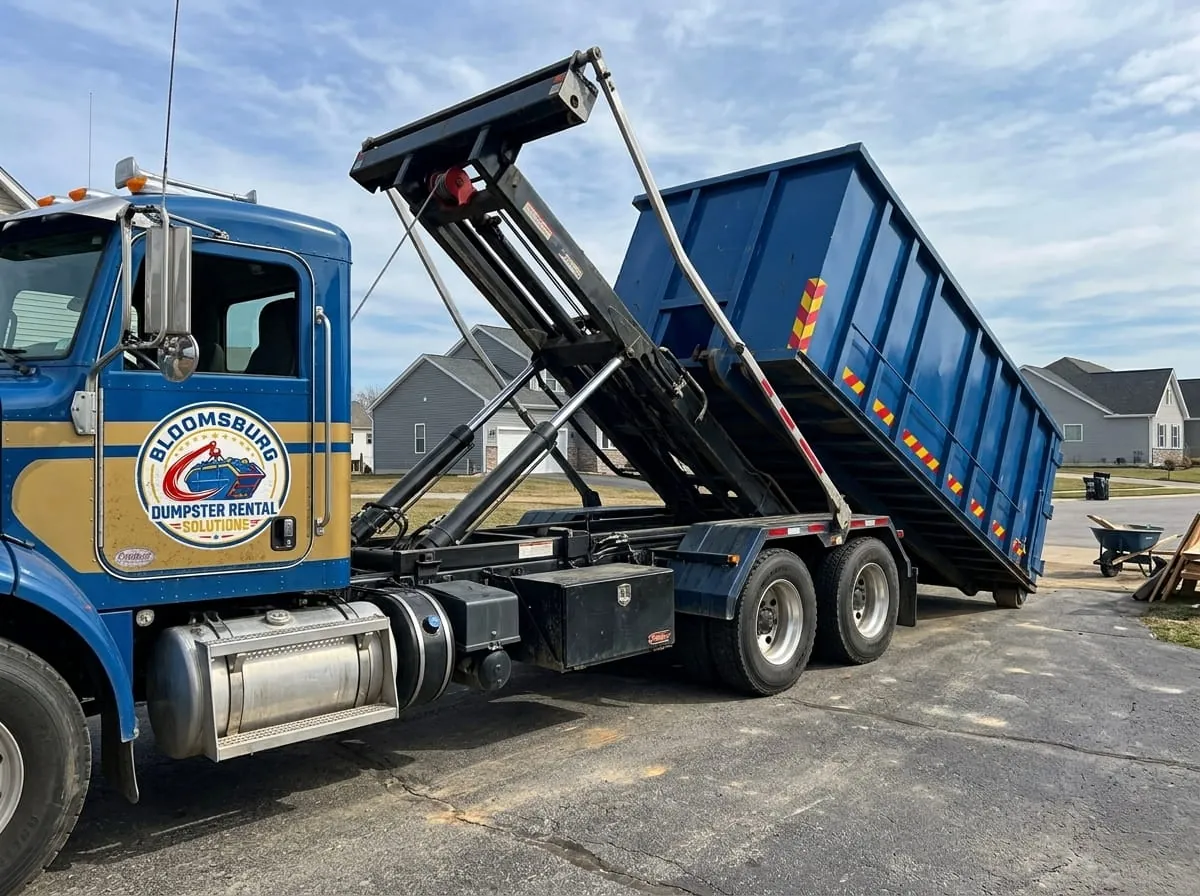
When you are ready to clear the rest, we are right here in Bloomsburg. Call (272) 203-8539 and we will help you figure out the right container and drop it exactly where you need it.
Step six: choose the right dumpster size so you are not paying for air or running out of room
This is the question I get most, and the honest answer is that most families over- or under-guess badly. Here is how I size an estate cleanout after walking thousands of them:
- 10-yard container — a smaller apartment or condo, or a house where family is keeping and donating most of the contents and you are only clearing the true trash. Good for a single heavy room like a packed basement.
- 15 to 20-yard container — the workhorse for a typical two- or three-bedroom Bloomsburg home where a moderate amount is being discarded. This is where most estate cleanouts land.
- 30-yard container — a full multi-generational household, decades of accumulation, a home with a finished basement and a packed attic and garage, or an estate where little is being kept.
- 40-yard container — hoarding situations or very large properties. If you are unsure whether you have crossed into this territory, you probably have; call and describe it.
A few practical notes for our area. If you are tossing heavy debris — old plaster, tile, a torn-out carpet, roofing from a garage — tell whoever you rent from, because weight limits matter more than volume with dense loads. Watch where the container lands; a driveway needs a board under the wheels to protect the surface, and a container on the street may need a permit depending on the borough. And do not forget appliances and electronics, which often have their own handling rules. A good local operator will walk you through all of this in one phone call rather than letting you guess.
If your situation is more about a few heavy items than a whole house — a couch, a dead refrigerator, a garage full of one relative's projects — sometimes straightforward junk removal is a better fit than a full container. And for the whole-house jobs, our dedicated estate cleanout service is built specifically for this, timelines, dignity, and all.
Doing it with dignity
I want to end where the checklists usually do not. This is not a demolition. You are closing out a life, and the way you do it becomes part of how you remember the person. Play their music while you work. Take breaks. Let yourself sit in their chair for a minute before it goes. Keep the thing that makes no sense to keep, if it brings you peace. And when the house is finally empty and swept, stand in the middle of it for a moment before you lock the door. That empty room is not nothing. It is the last thing you get to do for them, and you did it with care.
When you are ready, or even if you just need someone local to talk through the plan, reach out to us. We have helped a lot of Bloomsburg families through this, and we will meet you where you are — no rush, no pressure, just a hand with the heavy part.

Founder, Bloomsburg Dumpster Rental Solutions — sharing straight advice from more than 15 years of local hauling experience.